Pressure washing a roof vs scraping a roof? - What’s the difference
If you’ve started looking into roof cleaning properly, you may see two main approaches mentioned and this can be where a bit of confusion starts
You start Googling.
You look at a few contractor websites.
You might even ask ChatGPT what the “best” or “safest” option is for roof cleaning
Before long, you keep seeing pressure washing and scraping pop up:
- pressure washing (sometimes with hot water, sometimes not), and
- roof scraping with profiled tools
And naturally, you’re left thinking: which one should I be choosing?
For now, let’s set aside sales claims, scare stories, and “one-size-fits-all” answers.
This is just about understanding what each method actually does, where they differ, and why neither is automatically right or wrong for your home because both carry risks and benefits.
My hope for this is that you’ll have a better understanding, and can confidently make a more informed choice for your home.
Why the roof scraping vs roof pressure washing comparison causes so much confusion
When most people hear pressure washing a roof, they imagine force, High pressure, potential damage and think this surely can only be suitable for a driveway surely?
On the flip side, roof scraping sounds careful and controlled. It’s done by hand, so it sounds and feels safer for the tiles and mortar.
Those assumptions are understandable but its can also easy to assume a few things about the tools and how they're used.
A pressure washer is just a tool.
A scraper is just a tool.
The real difference comes down to how those tools are used.
How roof scraping tools are used for roof cleaning?
The roof scraping tools that are used to clean a roof typically have two attatchments at the end which are:
- a wire brush, or
- a profiled stainless-steel blade shaped to match the tiles
- sometimes the attachment are combined on the same tool holder
Its important to mention when cleaning a roof using these tools, aceess is usually gained via a scaffold tower or cherry picker, and sometimes by being on the roof itself, depending on steepness of the roof and how easy and safe it is to access.
When these roof scraping tools are used as either hand tools or attatched to long poles they are used to physically drag moss off the surface of the roof.
If you imagine thick clumps of moss sitting along tile edges, scraping is very effective at removing that bulk.
That’s why scraping appeals to many homeowners. It feels deliberate, controlled, and straightforward.
At its core, roof scraping is about removing what you can see.
What it doesn’t do on its own is deal with what’s left behind — the fine growth, spores, and organic matter living in and on the tile surface itself.
What is meant by pressure washing a roof?
This is where the language can be misleading.
Pressure washing doesn’t automatically mean high pressure. The pressure washing machine can have its pressure reduced so it can tackle many different surfaces if used in a professional roof cleaning environment.
When pressure washing is done properly on a roof, it typically involves:
- very low pressure
- controlled technique
- often the use of hot water into the cleaning process
Rather than relying on force to batter moss away, the aim is to
encourage growth to release from the tile surface along with the organic staining sitting on the surface of the tile.
Where hot water changes the "pressure washing" approach
Hot water plays a big role in roof cleaning with a pressure washer.
By heating the water — often somewhere between 60 and 100 degrees — organic growth like moss, algae, and lichen loosens more easily from the tile.
Using a boiler to heat the water means:
- less mechanical effort
- lower pressure can be used on the tiles
- and its a gentler overall process
Instead of scraping moss off with a tool, low-pressure hot water cleaning is about gently lifting and washing away what’s sitting on the surface of the tile in a consistent way without any jerking movements.
It’s worth mentioning that this method is still not suitable for every roof — age and condition always matter — but it’s very different from the “blast it clean” image we find some people have in mind when it comes to pressure washing.
The two big problems with Scraping and Pressure Washing a roof
This is the part that often gets oversimplified. Both methods can cause problems if they’re used without care.
So for this reason I wanted to share with you some of the main concerns that may or may not be on your mind when it comes to both methods of roof cleaning, starting with pressure washing.
Using a Pressure washer for roof cleaning - when force replaces judgement
With pressure washing, issues usually arise when:
- pressure is turned up too high
- speed is prioritised over restraint
- tiles are treated like ground surfaces
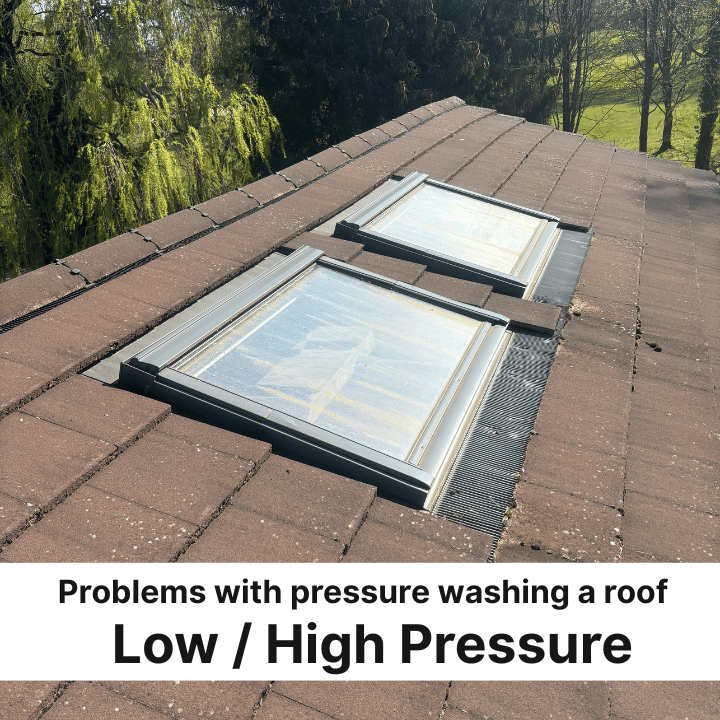
Roof tiles — especially on older Solihull homes — can be far more delicate than they appear. Excessive pressure can strip surface life from tiles or disturb mortar unnecessarily.
Roof Scraping - leverage and whipping motions
With scraping, the risk comes from leverage.
Scrapers are often used at the end of long carbon fibre poles.
At the end of the pole is a machined aluminium block that holds very hard stainless-steel blades that are used to scrape the moss off roof tiles.
As the tool is dragged up and down the tiles, a whipping motion can be used to move the pole and tool up and across the tiles.
The issues arise when having a machined aluminium tool at the end of a light bendy pole is used carelessly.
Roof scraping tools can create a whipping or slapping motion against the tile. The effect of this can:
- crack tiles as the tool slips or catches
- push and pull loose tiles out of position
- disturb tiles and mortar that are already poorly fixed
Both pressure washing and roof scraping.
Two different tools with the same issue
Too much force for the condition of the roof can causes damage.

Are you concerned by aesthetics, function or both?
The second shared problem is treating roof cleaning as purely cosmetic.
Scraping can make a roof look dramatically better straight away, but without follow-up treatment, regrowth can happen relatively quickly.
Using a pressure washer as a tool, correctly, cleans very thoroughly.
But if it’s done aggressively or without regard for the roof’s condition, it can shorten the life of the tiles.
Speed of roof cleaning results - pressure washing vs scraping
Assuming both methods are carried out professionally which make the comparison fair.
One of the the biggest practical difference for homeowners is Speed to get results.
If your have your home for sale, or have guests arriving and want to make a nice impression getting that instant results maybe most important to you
Or you might just be tired of sweeping your driveway and patio of moss every week and want to get the issue resolved and are completely okay with having the immediate roof cleaning "wow" result 6 months later?
Results from pressure washing (done properly)
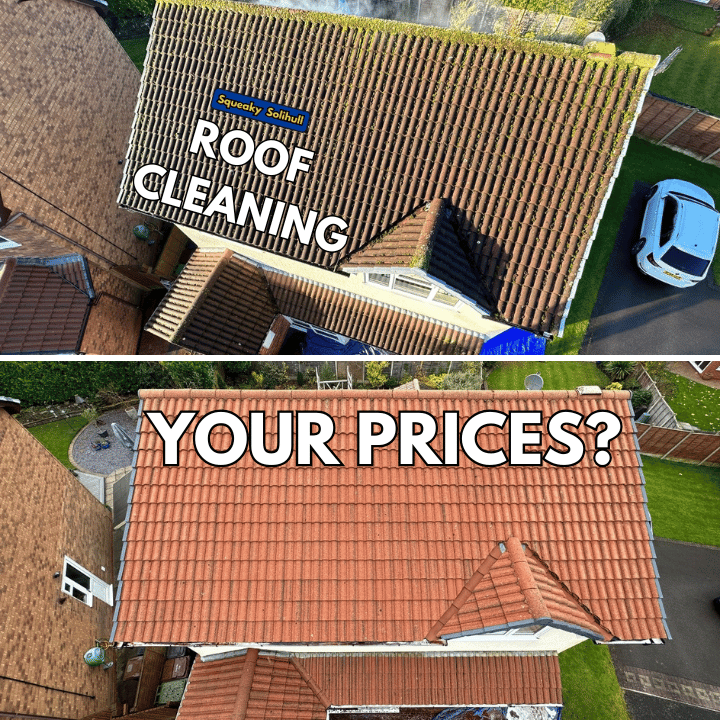
With low-pressure hot-water cleaning, results are immediate.
On the day of your roof cleaning:
- surface moss is removed
- organic staining is washed away
- the roof looks visibly cleaner straight away
For many homeowners, that instant change is reassuring and satisfying.
The job is complete, your roof looks amazing and there is no element of waiting to see a completely cleaned roof which you have with roof scraping.
Results from roof scraping
Roof scraping works more slowly overall.
Scraping is designed to remove the bulk of the moss, not to fully clean the tile surface.
Because of that, it usually relies heavily on a follow-up chemical treatment — most commonly a biocide which must be applied in dry weather to avoid dilution in the case of rain.
Biocide works gradually. It binds to organic matter and breaks it down over time which means:
- staining fades slowly
- remaining growth dies back over weeks or months
- final results can take up to six months
That slower timeline isn’t a downside for everyone - it’s just a different approach and something to consider so you are aware of it.
Which roof cleaning option suits you best?
You might want that instant visual result, the wow factor.
Or you maybe happy with a gradual improvement over time.
Some roofs can handle one method better than the other, and some roofs are best left alone or replaced.
That’s why there isn’t a universal “best” answer to which method is best in every situation for each home.
Useful ways to think about your roof cleaning decision
Rather than asking “is pressure washing or scraping better?”, some useful questions are:
- What condition are my tiles actually in?
- How delicate or weathered is the roof?
- Do I want instant results or gradual improvement?
- How will regrowth be managed afterwards?
- Is the contractor willing to if my roof is not suitable for roof cleaning?
A good roof cleaning contractor in Solihull, Birmingham or Warwickshire should be comfortable explaining those trade-offs.
You should feel comfortable with the contractor that's offering their roof cleaning service and they should be okay to decline your project if its not suitable for cleaning.
Our view at Squeaky Solihull is that pressure washing and roof scraping aren’t rivals. They’re just different tools.
Used with restraint and judgement, both can work well.
Used carelessly, both can cause problems.
Understanding the difference puts you in a calmer, better-informed position — and that’s exactly what we hope you feel as a homeowner when you are making a decision about having your roof cleaned.