Problems with pressure washing a roof (High / Low pressure)
When this topic comes up, most people already have a strong reaction for good reason.
You might initially be thinking “There is absolutely no way a roof should ever be pressure washed.”
You may have heard that from friends or family. You might have been told about it by a roofer.
You could even have heard it from another roof cleaning company especially if they're a purely roof scraping only company.
And to be fair, these reactions don't come from nowhere.
But like most things in exterior cleaning, the reality is more nuanced than simply saying pressure washing a roof is bad.
So rather than starting with broad statements, this article explains where the risks actually are, why they happen, and why professional roof cleaners talk so much about low pressure instead of force.
A Pressure washer as a tool for for roof cleaning
A pressure washer is just that, a tool.
On its own, it doesn’t decide how a roof gets cleaned. The operator does based on the tile and condition.
A pressure washer as a tool can:
- deliver water at very high pressure
- deliver water at very low pressure
deliver cold water
or, when paired with a boiler, deliver hot water
So the problem with pressure washing a roof isn’t automatically the machine itself.
The problem is how it’s used and on what type of tile
When people talk negatively about pressure washing roofs, they’re almost always referring to high-pressure cold water being used to blast moss off tiles.
That’s where things start to go wrong.
Risk one: forcing water under the tiles
Roofs are designed to shed rain water downwards towards the gutters.
Roof tiles are not a sealed system. They rely on overlap and gravity to work properly which is why roofs have a slope known as the roof pitch.
Even when using low pressure, cleaning tools can be adjusted to suit the surface thats been cleaned
If the nozzle is angled incorrectly, water can be directed upwards against the tile, bypassing the natural overlaps between tiles.
When that happens, water can pass under a tile and come into contact with the felt or membrane beneath the tiles.
From there, gravity takes over, allowing water to run into the
roof void or loft space and in most cases down the inner felt or membrane
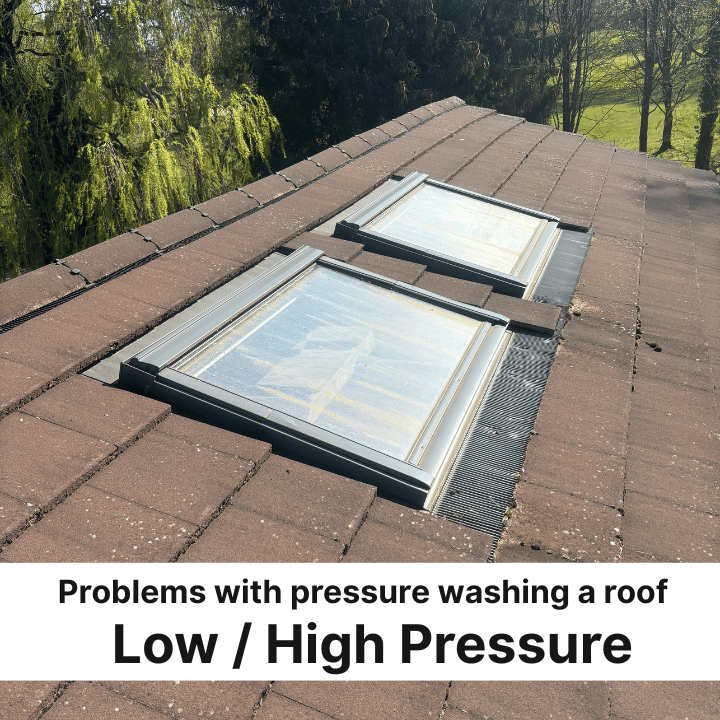
Risk two: Now my roof is leaking
One of the biggest concerns is that the roof can look completely fine on the day.
There may be:
- no broken tiles
- no visible damage
- no immediate signs of a leak
But if water has entered the loft during cleaning, dampness may only appear later which is naturally why this risk matters.
What this does not mean
If water enters under tiles during cleaning, it:
- Does NOT mean the roof is permanently damaged
- Does NOT mean rain will now leak in afterwards
- Does NOT mean the roof has failed
Rain behaves very differently to the method in wich a roof is cleaned at low pressure professionally.
Rain falls vertically and runs downwards. Cleaning water can be introduced at angles and flow rates rain would never naturally reach.
Risk three : stripping the protective surface from tiles
Another concern often raised is that pressure washing can strip the protective surface from roof tiles.
Most modern concrete tiles consist of:
- a concrete body
- a protective surface coating
That coating helps protect the tile from weathering and slows moisture absorption.
If high pressure is used, that protective layer can be worn away prematurely, exposing the raw concrete underneath.
Once exposed, the tile becomes more porous allowing it to hold moisture and organic matter more easily.
Ironically, this can lead to
faster moss regrowth, even though the roof looks very clean initially.
Does low pressure roof cleaning change this conversation?
It wouldn’t be fair to say that any use of a pressure washer damages tiles.
When roofs are cleaned using low pressure, especially when paired with hot water, the aim is:
- to remove organic growth
- without excessive mechanical abrasion
- and without stripping tile surfaces
Again, the issue isn’t the tool — it’s the force applied.
Newer tiles vs older tiles: what actually matters
People often assume newer tiles are always safer to clean.
A “newer” roof is typically around 10–15 years old, and many of these tiles still retain their protective coating.
However, experience shows it’s not that simple.
Certain tile styles — particularly darker colours — can begin to lose surface coating naturally within 5–10 years, even before cleaning.
UV exposure, weathering, and manufacturing differences all play a role.
Cleaning older tiles safely
As tiles age, protective coatings often wear away.
That doesn’t automatically mean the roof can’t be cleaned.
We regularly see:
- 40–60 year old concrete tiles that are thick, dense, and structurally sound
- tiles with no surface coating left that still tolerate careful low-pressure cleaning
At the same time, we also see:
- much newer tiles that are thin, fragile, and already deteriorating
In those cases, no cleaning method is appropriate, not pressure washing, not low pressure, and often not even manual scraping.
If a roof isn’t suitable, it shouldn’t be cleaned at all.
Risk Four: ridge mortar being disturbed during roof cleaning
Another common argument is that pressure washing can “blow out” ridge mortar.
And yes, it can.
But it’s important to understand why.
Ridge mortar is often the most delicate part of a roof. In many cases, it hasn’t been maintained for 20 years, 30 years, 40 years or more
Moss frequently grows in cracks along ridge lines, holding moisture, freezing, thawing, and expanding year after year.
Sometimes that mortar is already compromised and being held together by moss alone.
Cleaning doesn’t always cause the problem — it reveals it
When moss is removed, the true condition of the ridge becomes visible.
In some cases:
- mortar looks fine before cleaning
- but may crumble once the moss is removed
That can feel like the damage has been caused by cleaning, when in reality the issue already existed.
Even brushing moss off by hand very delicately can dislodge failing mortar.
If you have ever seen a patio with mortar holding the patio slabs in place, this mortar naturally can fail over time and is a common sight around homes which is the same principle for the mortar on a roof ridge.
How professionals handle ridge areas when roof cleaning
Professional roof cleaning should treat ridges with extra care.
That means:
- avoiding force
- not trying to mechanically remove every last bit of moss
- allowing softwash or biocidal treatments to deal with delicate areas over time
The goal is not to rip material out, but to
clean responsibly and where appropriate allow the post treatment chemicals to remove the moss rather than by mechanical means.
A few things you can look out for as a homeowner before having your roof cleaned
Without climbing onto your roof, you can still take note of a few basics:
- Does the roof appear generally intact, or are there obvious slipped or broken tiles?
- Is the ridge line straight and continuous, or does it look uneven or heavily degraded?
- Is moss sitting on the surface of the tiles, or does it appear to be growing within gaps and joints?
- Has the roof ever had any maintenance carried out on ridges or verges in the past?
None of these automatically mean a roof can’t be cleaned. But they’re useful indicators that a professional should be looking at carefully before recommending any method.
Questions worth asking a roof cleaning company
Rather than focusing on price first, it’s often more helpful to ask a few simple questions about how the work will be done and to identify the competency of the company that you’re considering for the work.
Good questions include:
- What pressure will actually be used on my roof? (1000-1500 psi)
- Will the water be heated, or is it cold water?
- How do you avoid forcing water under tiles?
- How are ridge tiles and delicate areas treated?
- What happens if cleaning exposes existing issues like loose mortar?
- Are there situations where you would advise not cleaning a roof at all?
A reputable company should be comfortable answering these without rushing or dismissing the concerns and should equip you to make a confident choice.
Squeaky Solihull view on roof cleaning
Roof cleaning shouldn’t be about force, shortcuts, or guarantees that nothing will ever move or change.
Our focus is on understand how the roofs are built and recognising which areas are delicate
From there we can choose which methods will minimize risks that are present at each property, and in some cases we just aren't the right company to tackle that project.
Sometimes cleaning improves a roof.
Sometimes it reveals maintenance that was already overdue.
And sometimes the right decision is
not to clean at all.
Again, the choice is always with you and we hope that you have all the information to make a better decision when it comes to having your roof cleaned.